How can two different paper formats be packaged using a process that is both flexible and automated? item pluspartner KMV Müller created a fully automated packaging system with palletizing, four robots and camera-based quality control for this very purpose.
KMV Müller in Dresden is a member of the item pluspartner network and specializes in building customized special-purpose machinery. KMV’s team of mechanical and software engineers develops automation solutions – from design and programming all the way through to commissioning. At the request of a paper manufacturer based in the German state of Saxony, the company created a fully automated packaging and palletizing system with four robots, camera-based quality control and flexible format switching. This solution uses profiles from the item Building Kit System, as well as item conveyor belts and linear technology.

Bruno Müller, Managing Director of KMV Müller
Industrial solution experts for a range of sectors
You, too, can benefit from the item pluspartner network’s extensive experience and industry-specific expertise – for everything from creative subprojects to innovative complete solutions. Find the ideal item pluspartner in your region for your project!
KMV Müller – building special-purpose machinery with solutions from a single source
KMV is an owner-run company and offers a wide range of services – from mechanical and electrical design through to PLC programming, robot integration and full commissioning at the customer’s factory.
KMV uses tried-and-tested industrial components such as Siemens controllers and EPSON and FANUC robots, as well as the item Building Kit System for its machine bases and enclosures. From the initial sketch right through to operator training, everything is supplied from a single source.
Two paper formats – one end-to-end automated process
In the paper industry, once paper has been cut to size, it is shrink-wrapped and then packed in boxes. KMV’s customer produces two different sheet sizes – a small format measuring 180 × 280 mm and a large format measuring 360 × 280 mm. Packaging had previously been a largely manual process, but growing production volumes meant this approach was increasingly reaching its limits.
The new system therefore had to be capable of processing both formats fully automatically. The customer also requested a hybrid mode that would allow the two formats to be processed in parallel. At the same time, however, manual packaging still needed to be possible if necessary, without having to shut down the entire system. Another key requirement was for the packs of cut sheets to undergo a quality control process prior to packaging so that defective products could be rejected at an early stage.
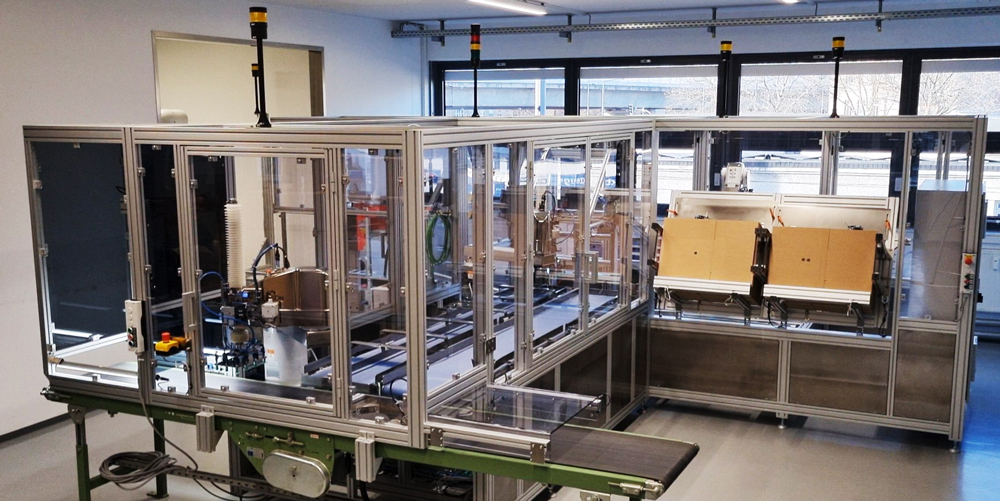
KMV Müller’s fully automated packaging and palletizing system can handle two paper formats and takes care of the entire process, right through to the fully loaded pallet.
A packaging system with five stations – from pack to pallet
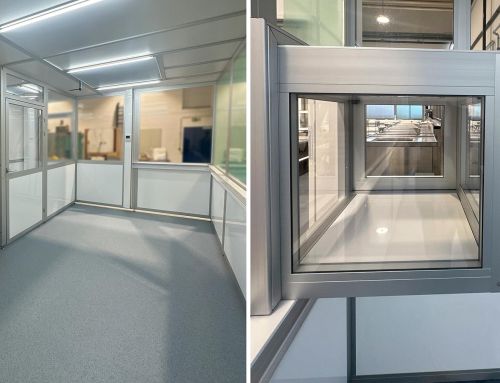
The system developed by KMV covers the entire packaging process across five coordinated stations, starting with the infeed of the shrink-wrapped stacks of paper and ending with the fully loaded pallet. From the camera station to the box sealer, the system is fully enclosed. This closed design based on item aluminium profiles protects the process and meets the EU Machinery Directive’s safety requirements.
1. Quality control and implementation
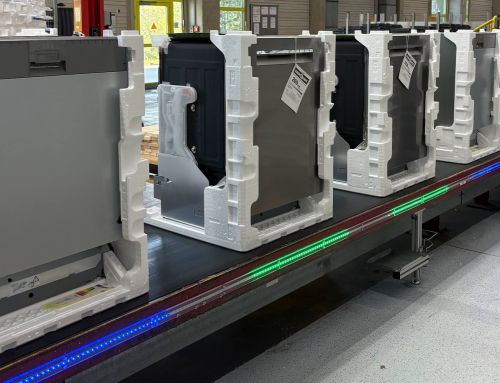
The shrink-wrapped stacks of paper enter the system on a conveyor belt. First of all, a camera detects the position of each pack on the belt so the SCARA robot can get into the correct position to pick it up. At the same time, the camera checks that the shape and alignment of each pack are as they should be. Packs that don’t meet the quality criteria are automatically rejected. This ensures only defect-free products proceed to the packaging stage.
After the camera station, a film printer adds the necessary printed information to the packs as they pass it. This printing function works both in automatic mode and in continuous mode for manual packaging.
The SCARA robot then picks up the packs and deposits them on the correct conveyor belt for the relevant format so they can be transported to the station where the packaging process takes place.
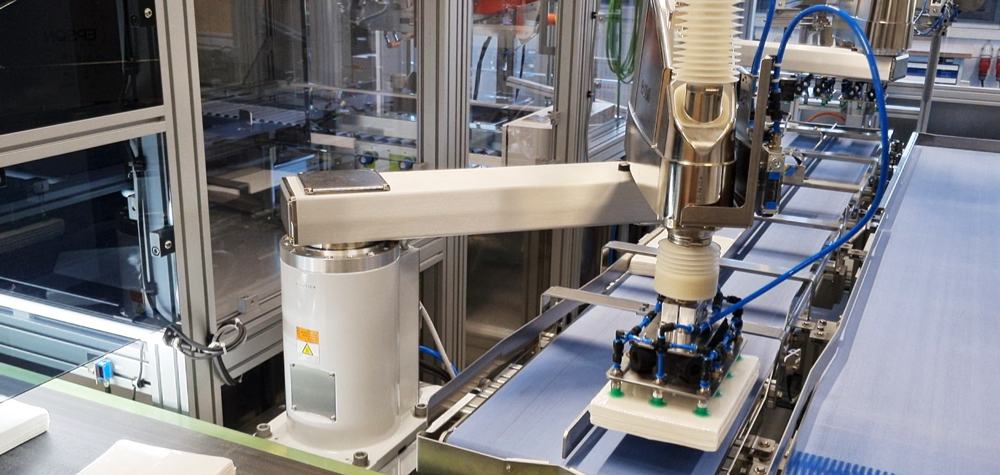
A robot picks up the packs of paper and forwards them for automated packaging.
2. Box erecting
An EPSON 6-axis robot takes the flat blanks from a magazine and erects the boxes. The blank feeder has two magazines to automatically supply the appropriate type of blank depending on the format selected.
3. Box filling
A second SCARA robot fills the erected boxes with packs of paper in layers. Thanks to a height-adjustable guide for the box opening, the packs are placed in the box with precision. This ensures a smooth filling process without any damage.
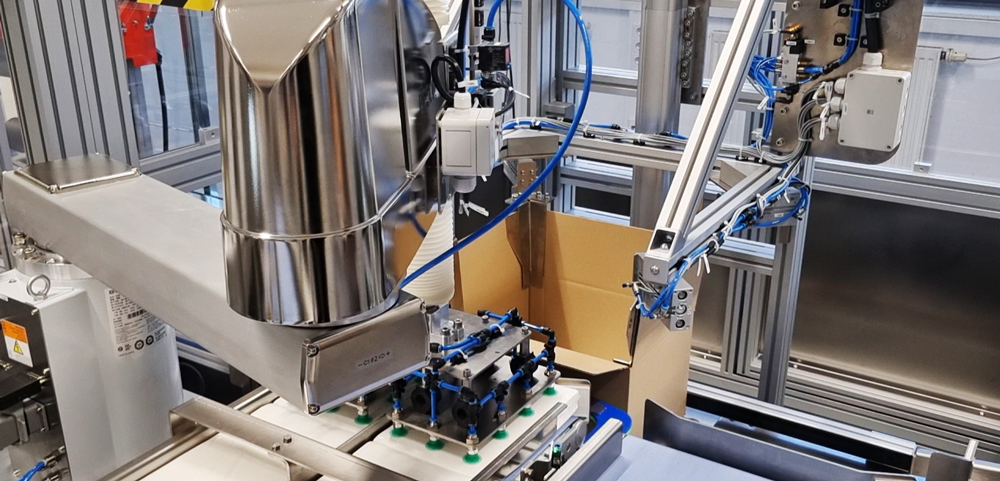
The SCARA robot places the packs of paper in the erected box with precision.
4. Box printing and sealing
As the filled boxes pass along the conveyor, the relevant article information is printed on them upstream of the sealer. They then pass through the automatic sealer, which folds down the flaps and seals them using adhesive tape.
5. Palletizing
At the final station, a FANUC CRX industrial cobot loads the boxes onto pallets. It uses vacuum grippers to pick up the sealed boxes and stack them in layers on Euro pallets. In hybrid mode, the robot loads two pallets simultaneously – one for the small format and one for the large format. Once a pallet is fully loaded, the system activates an indicator light and an acoustic signal to tell the operator that the pallet needs to be changed.
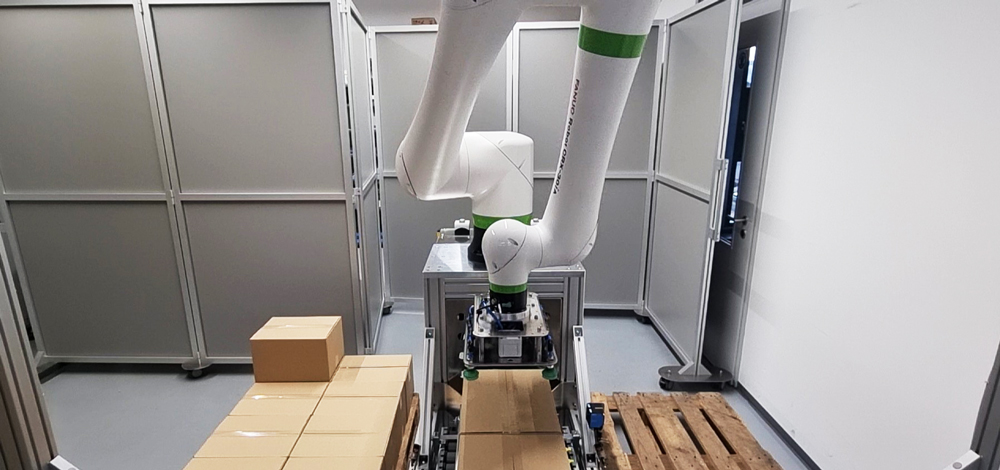
A FANUC cobot automatically loads the sealed boxes onto pallets.
A packaging system based on profile technology
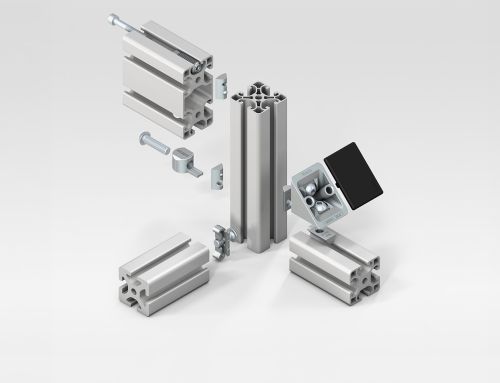
The item Building Kit System provides the mechanical basis for the whole packaging system. The machine base and the entire enclosure are made from Line 8 aluminium profiles, primarily Line X profiles. In addition, profiles in the heavy-duty design are used in areas where particularly high loads occur.
“With the item Building Kit System, we can create a modular mechanical basis and modify it if necessary, even after commissioning.”
“When building special-purpose machines, each system is unique. With the item Building Kit System, we can create a modular mechanical basis and modify it if necessary, even after commissioning. That gives us and our customers peace of mind that the system can grow in line with new requirements,” says KMV’s Managing Director Bruno Müller.
All processes from the camera station to the sealer take place in an enclosure that is also based entirely on item profile technology. Swing doors with safety locks allow controlled access for maintenance and troubleshooting.
item components are used for internal parts of the system, too. The conveyor belts transporting products between stations are based on item solutions, as are the linear units that ensure precise positioning movements. The consistent use of a standardized profile system doesn’t just simplify design and assembly, but also makes subsequent spare parts procurement and on-site maintenance more straightforward.
Flexibility at the touch of a button
The entire packaging system is controlled by a Siemens PLC and benefits from convenient touch panel operation. A format management function enables operators to choose between different “recipes” – small format only, large format only or hybrid mode for the simultaneous handling of both formats.
The format can be changed at the touch of a button, with no mechanical reconfiguration required. Speeds, numbers of layers and palletizing parameters are applied automatically in line with the selected recipe.
The system also offers a continuous mode for manual packaging. In this case, the packs of paper travel along the conveyor belt and are still printed by the film printer, but without any robot intervention. At the end of the conveyor, they can be removed and packed manually. This mode, too, benefits from camera monitoring to track the products’ position as they pass through the system.
Fully automatic, flexible and designed to enable future modifications
Assembly and commissioning took place at KMV in Dresden. The system was then installed at the customer’s factory at the beginning of 2026 and underwent a successful acceptance inspection. It reliably packages both format sizes and achieves far greater consistency than the previous manual process. Thanks to the modular design based on item profile technology, the customer can flexibly modify the system in the event of future changes to products.