Aluminium profiles – invention, quality and cost-effectiveness
At first glance, all aluminium profiles might look the same – but take a closer look and you’ll soon spot some big differences. In this blog post, we set out the relevant criteria to help you decide which ones to buy.
Aluminium profiles – the key facts
- Sales of the MB Building Kit System started in 1984. Today, the system – now called the item Building Kit System – includes over 4500 compatible components.
- Original aluminium profiles offer documented, reproducible properties in terms of the alloy used, tolerances, surface quality and fastening techniques.
- Premium profiles deliver excellent reliability, streamlined assembly and maintenance work, a more expansive system and comprehensive support.
- item profiles are top-quality products that can be used for decades. What’s more, they are made from over 50 percent recycled material.
- The award-winning item design combines form and function, which ensures better ergonomics and greater flexibility in engineering and assembly.
Who invented aluminium profiles?
There have been various technical milestones in the development of aluminium profiles – the first extrusion process (Joseph Bramah, 1797), the affordable production of aluminium (Hall-Héroult process, 1886), early uses of extruded aluminium profiles (around 1900), and the item invention of a modular aluminium profile designed for mechanical engineering applications (1980).
item played a pivotal role in shaping and improving the classic aluminium profile that is now widely recognised in the industry as a key structural element (also known as a grooved profile):
- Making machine bases from steel had many disadvantages – steel is heavy and difficult to machine, which slows everything down. That’s why, in 1980, Pies and Rixen came up with an alternative solution – using aluminium instead of steel and screws instead of welds.
- Even back then, aluminium profiles featured the 8 mm groove on all four sides.
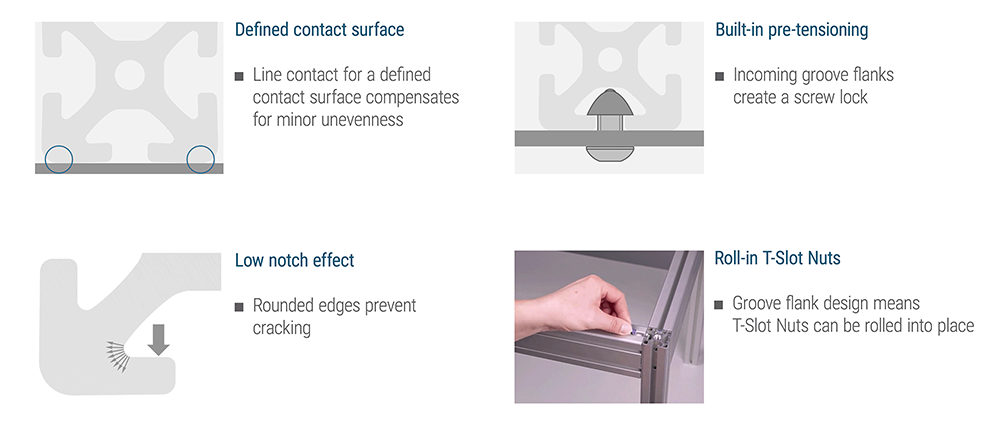
- In 1983, the profile geometry was modified to incorporate inward-sloping groove flanks. This made built-in pre-tensioning possible – a feature that is still proving very effective to this day.
- Even back then, the profiles in question were the Profile 8 40×40 and its “sister profile”, Profile 8 80×40 – and these are still the basic profiles for the present-day item Building Kit System.
After non-stop development work, the MB Building Kit System went on sale in 1984. Back then, communicating the benefits of modular aluminium profile systems to a wide range of customers was truly pioneering work. The product portfolio has never stopped growing and currently includes over 4500 compatible components. As the system is now used in applications that extend far beyond mechanical engineering, its name has changed from the MB Building Kit System (MB stands for mechanical engineering in German) to the item Building Kit System.
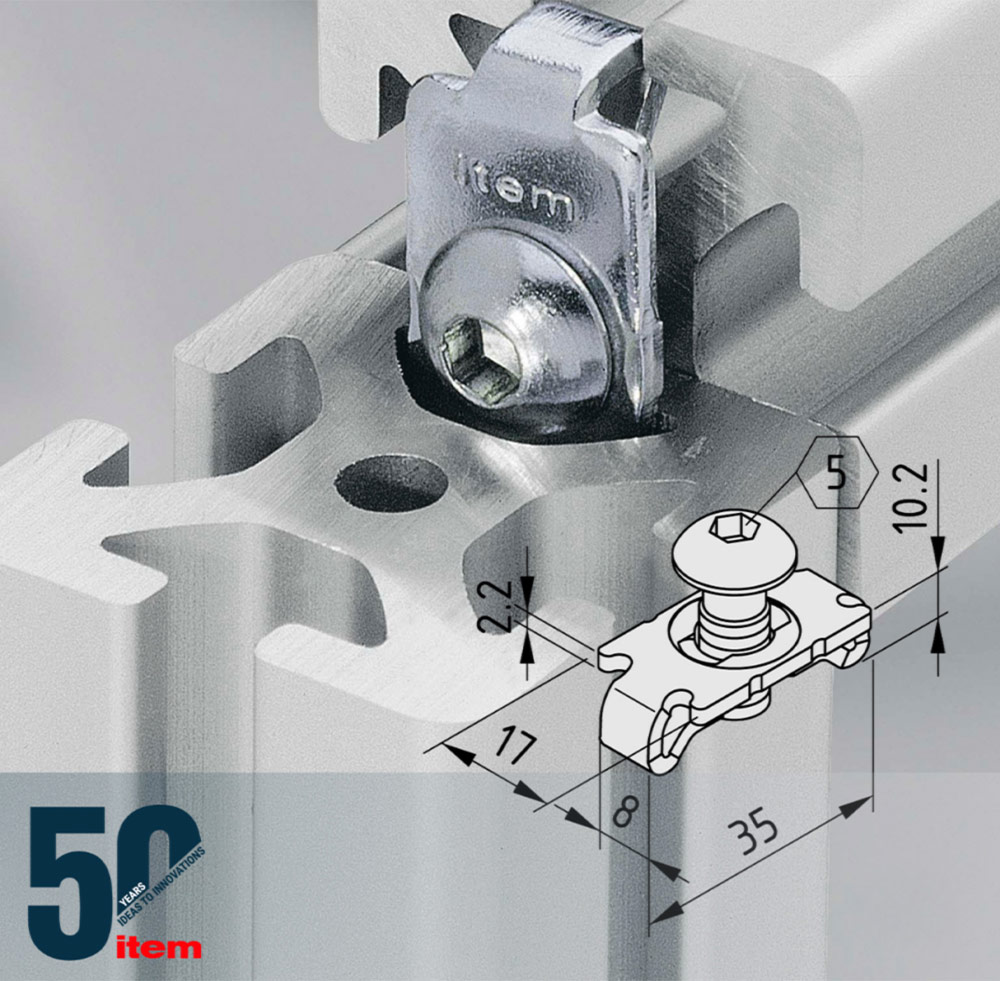
The patent for a fastening technique featuring a washer with anti-torsion protection was particularly significant. This fastener was stable, concealed and systematically engineered. As the predecessor of today’s Standard-Fastening Set, it combined consistent force transmission with mechanically locked anti-torsion protection. Based on the same principle as the original idea, the Standard-Fastening Set is an integrated element that is easy to install.
How do you tell when one aluminium profile system is better quality than another for industrial use?
Material, surface finish, tolerances, fastening technology and the scope of the system are the key quality indicators for aluminium profile systems designed for industrial use.
Pay particular attention to the following criteria:
- Material quality: A clearly defined alloy and verifiable technical characteristic values are an indication of reliable, reproducible properties.
- Tolerances and dimensional accuracy: Straight profiles, precise angles and perfectly coordinated accessories ensure stable connections, without any need for readjustments.
- Rigidity: A high-quality profile system exhibits minimal deflection and torsion under load.
- Surface finish: A smooth, uniform surface offers long-term protection against corrosion, wear and tear.
- Fit of accessories in grooves: Grooves that are free of any burring, as well as T-slot nuts and fasteners that are free from play but move smoothly, are also a sign of good manufacturing quality.
- Fasteners: Stable, torsion-resistant fasteners continue to work reliably, even after being installed repeatedly.
- Scope of system and documentation: A wide range of accessories, availability of CAD data, and detailed installation and assembly guides make planning and implementation easier.
- Delivery reliability and support: Fast availability, long-term delivery reliability, expert technical advice, online support and rapid complaints processes give you the planning certainty you need.
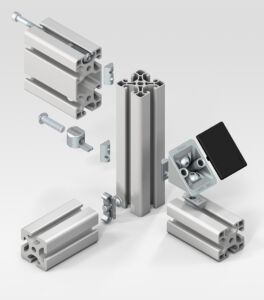 System for maximum versatility
Opt for the original item Building Kit System and enjoy the benefits of our unique range of products.
The end-to-end compatibility of all components gives your creativity a whole new dimension.
Why do some aluminium profile systems cost more than others?
Aluminium profile system procurement costs can vary considerably, depending on both the supplier and the design. This is due to specific technical and organisational factors, ranging from the material and production process used to the service and digital support offered.
Here is an overview of the various factors:
- Material: High-quality aluminium alloys boast a better load-carrying capacity, and their properties are more clearly defined. These materials therefore cost more than simpler alloys.
- Wall thickness and weight: The more aluminium there is in a profile, the more material is needed and the higher the costs. However, rigidity and load-carrying capacity are also enhanced. A thinner-walled profile is usually sufficient for lightweight frames, but it’s best to use thicker-walled profiles when building machine bases, guards and enclosures.
- Surface finish: Anodized profiles offer key advantages, including better protection, corrosion resistance and visual appeal. That means they also cost more than untreated profiles.
- Dimensional accuracy: Profiles with very low tolerances require greater manufacturing precision and extra quality controls. This additional work means these profiles are more expensive to buy, but they also boast a more precise fit. Components can therefore be aligned more precisely, and less rework is required when installing them.
- Development and innovation: System suppliers such as item factor in the investment costs associated with developing new components, extending ranges and ensuring continuous improvement. Although this has an impact on prices, it also means customers benefit from a much bigger range of systems and components.
- Service and digital ecosystem: The differences between aluminium profile systems aren’t restricted to the products themselves – they also include warehousing (to ensure fast availability), technical advice, documentation and digital support, complete with planning tools.
What’s the difference in quality between original aluminium profiles and replicas?
The main differences in quality between original aluminium profiles and replicas relate to the alloy used, heat treatment, manufacturing tolerances, profile geometry and surface finishing. Manufacturers of original aluminium profiles – such as item – coordinate and document these properties across the entire profile system. This ensures consistent quality, end-to-end compatibility and reproducible results, both at the assembly stage and during subsequent use. In the case of replicas, this information is sometimes missing or the material properties may fluctuate widely.
Key differences at a glance:
- Material and alloy: In the case of original profiles, the alloy that has been used and the heat treatment they have undergone is clearly stated and documented, so a better evaluation of their strength characteristics is possible. This information is sometimes less complete for replicas, so it’s harder to evaluate the actual material properties.
- Wall thickness, internal geometry and weight: Many replicas have less material in them or differ from the original profiles in terms of their internal geometry. Thinner walls or an inferior arrangement of the internal webs can reduce stability and lead to increased deflection and torsion under load.
- Dimensional accuracy and tolerances: When manufacturing its original profiles, item ensures that the external dimensions and groove geometry are kept within defined tolerances. This means you can rest easy in the knowledge that our T-slot nuts, fasteners, caps and other accessories will all be compatible. If there are variations in the groove width or depth of replica products, accessories may get jammed, exhibit play or fail to hold securely.
- Surface finishing: High-quality profiles have an even, anodized surface coating that offers better protection against corrosion, wear and tear. In the case of replicas, differences in the thickness of this coating and the quality of the anodized surface can compromise both the corrosion resistance and the look of the profile. These differences are most obvious at the edges, because an anodized surface covering that is uneven or too thin is more likely to chip
at the cut edge when the profile is sawn. - Machining: Sawing, drilling and thread cutting are all easier when the material properties and profile dimensions are always the same. Variations in the material properties and profile dimensions can make replicas harder to machine and may result, for example, in higher levels of burr formation or unclean threads.
- Compatibility of accessories: Original accessories are designed for the groove geometry and tolerances of the system. Using replicas can therefore cause compatibility issues if the groove geometry or dimensions aren’t the same as those of the original product.
High-quality aluminium profiles versus cheap alternatives – which option is more cost-effective in the long run?
High-quality aluminium profiles are more cost-effective in the long run in many areas of engineering. This is because they offer a crucial combination of a defined material specification, narrow tolerances for the dimensions and groove, and a consistent surface quality. This results in a longer service life, reduced maintenance needs, more straightforward reconfigurations and, consequently, significantly lower lifecycle costs.
Below is a detailed comparison of premium profiles and cheap alternatives:
Statics and service life (total cost of ownership)
- High-quality profiles are made from clearly specified aluminium alloys. This choice of material, combined with controlled heat treatment and unchanging manufacturing conditions, means that mechanical properties can be kept consistent from one batch to the next. Other crucial factors include excellent dimensional accuracy and consistent groove geometries, as this ensures that fasteners can be fitted reliably and components can be aligned precisely. Provided they have been designed appropriately and in compliance with the permitted load range, constructions will remain stable.
- Cheap alternatives may exhibit greater dimensional deviation in the profiles and grooves, so it isn’t always easy to combine these with fasteners and accessories from the same system. This can lead to more work for alignment and improvements, with the knock-on effect of extra costs when reconfiguring or expanding solutions.
Corrosion protection and appearance
- Premium profiles are anodized as standard (item profiles: E6/C0 and E6/C35). Anodising involves creating a protective oxide layer on the aluminium surface. An oxide layer of a defined thickness and appropriate density contributes to excellent corrosion resistance. What’s more, anodized profiles look good, have an easy-to-clean surface and offer consistent quality over the long term.
- Cheap profiles have an uneven surface quality and top layer. The signs of this are a profile that develops staining, goes dull more quickly or has a patchy appearance. In challenging environments, inadequate surface treatment can also reduce corrosion resistance, so corrosion is more likely to occur.
Installation work
- High-quality profiles offer end-to-end compatibility with a wide range of accessories, including fasteners, T-slot nuts, brackets and hinges. Thanks to precise profile and groove dimensions, excellent dimensional accuracy is ensured. This speeds up the installation process and makes it easier to expand or reconfigure solutions.
- Cheap alternatives – both profiles and associated components – can exhibit bigger variations in terms of dimensions and tolerances. This leads to limited compatibility within the relevant system or makes extra adjustments necessary. In turn, this increases the amount of assembly, installation and reconfiguration work required, especially since sub-standard fastenings have a detrimental effect on both stability and process reliability.
Cost-effectiveness – the verdict
- High-quality profile systems can be more cost-effective, especially when short project timelines, high availability, subsequent expansions, or reduced planning, assembly and installation outlay are key factors. There are multiple reasons for this – not only the fast, reproducible results, but also the long-term availability of components, technical advice, digital planning aids, and less outlay for maintenance, expansion and reconfiguration work.
- Cheap profiles may offer an economical solution for simple applications with minimal requirements in terms of load-carrying capacity, compatibility and long-term expansion options. However, whether a cheap or a high-quality profile system will be more cost- effective in the long run depends on how the construction is going to be used. In the case of long-term use, high-quality systems can result in lower lifecycle costs due to the reduced levels of assembly work, maintenance and adjustment needed.
Are item profiles sustainable?
Yes, item profiles are sustainable, because they are designed for a long service life and can be reused and recycled. These benefits are possible thanks to the use of aluminium, the modular nature of the building kit principle and the continuous development of the item Building Kit System.
The sustainability of item profiles in detail:
- Modular building kit principle: Thanks to the item modular design principle, you can reconfigure your constructions whenever you like. When you dismantle a construction, you can reuse all the profiles for a new solution. The end-to-end compatibility of the item system means you can even combine new components with parts you have had for decades, for example.
- A high proportion of recycled material: Aluminium profiles are made from over 50 percent recycled material. Both aluminium and aluminium chips are recycled. After being melted down, the aluminium is reused – and this requires a mere tenth of the energy consumed when manufacturing it from scratch.
- Particularly sustainable alternative: WFC profiles from item have been designed as an innovative alternative to aluminium profiles for specific purposes. These WFC profiles are made from the wood-based material GCC HOLZart (with GCC standing for German Compact Composite). This material was awarded a Gold certificate by the Cradle to Cradle Products Innovation Institute and even achieved Platinum certification in the Material Health category in recognition of this product’s non-hazardous constituents. After use, the material can be fully reprocessed and used to manufacture new profiles.
item has won many design awards – what exactly does that mean for customers?
These design awards give customers confidence that the ingenious design of item products will offer functionality, versatility and durability. Even in the concept phase, the focus is on excellent design. The design team and staff from the product development department work closely together in a relationship built on trust. The result is a perfect combination of form and function, as testified by numerous design awards, including the iF Design Award, the German Design Award and the Red Dot Design Award.
In a nutshell, the award-winning item design offers the following benefits:
- Less wear
- Ergonomic installation and use
- Flexible use in terms of the installation site and assembly method
- Flexible configuration
- New options for installation thanks to the lack of protruding contours
- Less risk of injury
Product designer Carsten Schulz sums up the item design philosophy as follows: “Fundamentally, item products have a very classic, subtle design. Form is also given equal priority with function, because that is the benchmark we have set ourselves. The founders and owners of item shaped that philosophy. Both are very hot on design. That’s why this philosophy has always been at the heart of what we do.”