Playing billiards. Four students have developed a fully automated billiard robot in a project that is as innovative as it is spectacular.
Billiards is all about precision, timing and the right angle. Few sports require such high levels of concentration and spatial awareness. Virtuoso shots are even more amazing when it’s not a human who is hitting the billiard balls with such expertise, but instead an intelligent robot system that recognises the balls on the table, calculates shots and executes them all by itself.
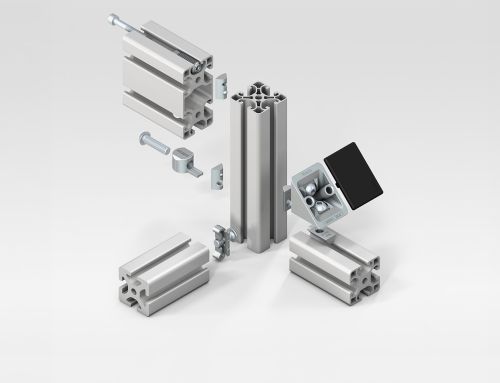
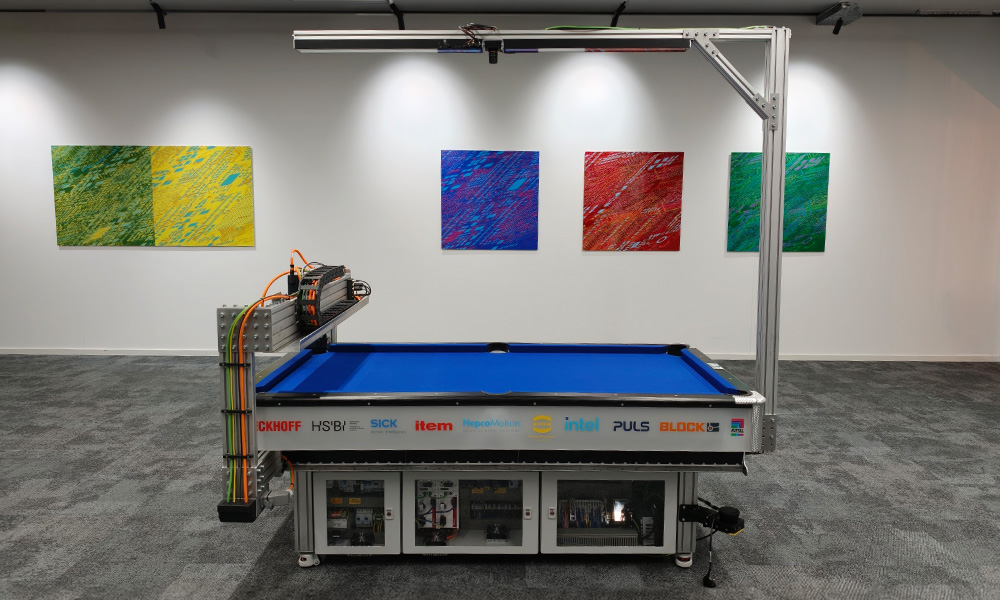
That’s exactly what a four-strong team at the Gütersloh campus of Hochschule Bielefeld University of Applied Sciences and Arts (HSBI) has achieved. All students on the work-integrated Bachelor programme in Mechatronics and Automation, they have created the fully automated B.R.E.A.K. billiard robot in a project spanning two semesters. B.R.E.A.K. is the acronym for the robot’s full name in German, which translates as “billiard robot for the autonomous execution of shots”. This robot system can play independently against human opponents. The modular profile technology of our item Building Kit System was used to build the base frame and other elements.
 System for maximum versatility
 System for maximum versatility
Opt for the original modular design solution and benefit from the diversity of the item Building Kit System. The end-to-end compatibility of all components gives your creativity a whole new dimension.
From dream to reality – how B.R.E.A.K. came about
The fact that all team members are students on the work-integrated programme means they are continuously switching between theory (at the university) and practice (at a partner company). Ben Donkervoort has finally been able to realise a long-cherished vision. “Even before I started the degree programme, I had the idea of building a billiard robot one day,” he reveals. Donkervoort became the team leader and took charge of the management and design engineering side of things. Together with Antoine Angert (software and image recognition), Michael Wilhelmstroop (electronics and design engineering) and Niklas Hils (electronics and software), he turned the idea into a concrete project as part of the study programme. The task during the sixth semester was to prepare the specification documents, and the project itself was carried out during the seventh semester.
It was by no means certain that B.R.E.A.K. would even get the go-ahead. The students’ supervisor originally thought it was too ambitious. That led the team to build an initial prototype in the space of a week to prove the project was feasible. The proof of concept also produced some initial findings regarding the necessary rigidity of the frame and guides. The impact force that had been calculated was verified, too. In addition to this, publicly available training data was used to try out identifying the billiard balls and recognising their position – with successful results. This high level of commitment won over the professor, and the project finally got the green light.
How the billiard robot works
“The robot starts by using a camera that is attached to the top of the structure along with the lighting to recognise the position of the balls,” says the project leader, explaining the basic principle. During this process, the monochrome camera generates a coloured image with flash sequences in blue, green and orange. A machine learning model then recognises and classifies the balls. Any lens distortion is corrected automatically. The next step is for a software program to calculate the optimum shot based on a physics simulation and the rules of the game. Playing off the cushion isn’t possible just yet.